# Phone-Free Schools and Achievement Growth: A Student-Level Analysis
## Phone-Free Schools and Achievement Growth: A Student-Level Analysis
CEPR presents the first national analysis of school cell phone bans using student-level achievement growth in the United States. The bans under examination focus on restricting student cell phone use by requiring students to keep their phones in lockable pouches.
[ Read the press release arrow\_circle\_right ](https://cepr.harvard.edu/cell-phone-press-release)
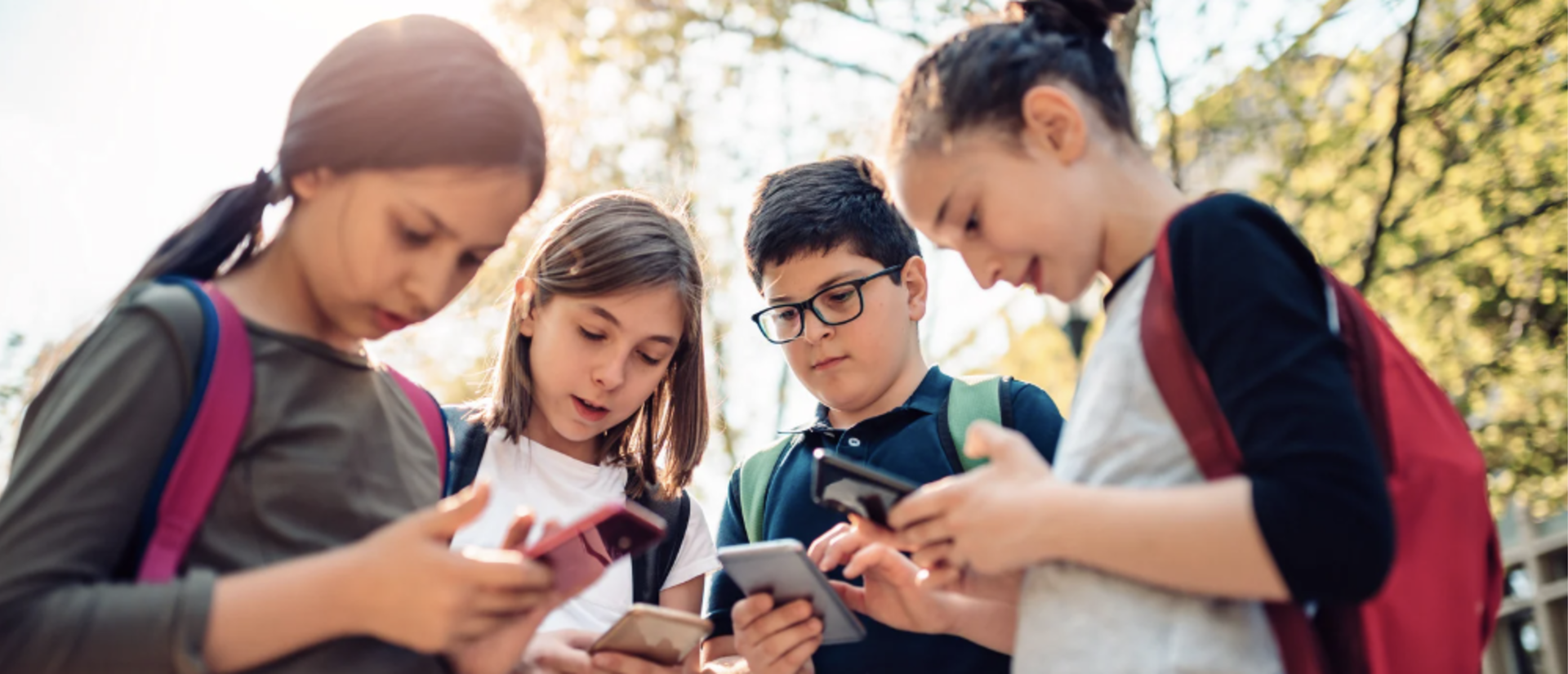
The study ultimately finds that **schools implementing strict cell phone bans using lockable pouches saw modestly higher achievement growth in math and reading—about 1 to 2 weeks of additional learning per year,** a boost in annual learning equivalent to half of the annual gradual decline in achievement since 2013.
## Download the Report and Resources
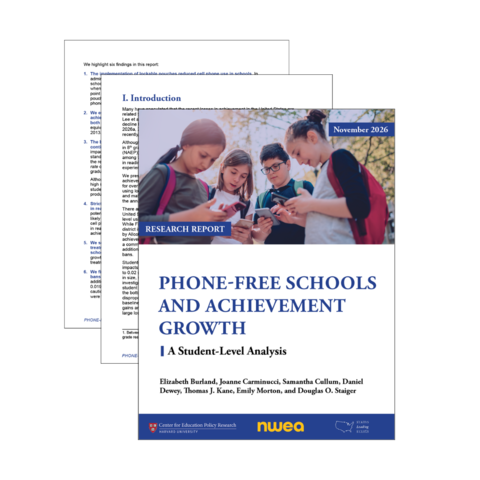
[### Phone-Free Schools and Achievement Growth: A Student-Level Analysis
](/resource/phone-free-schools-report)This report—the first national analysis of school cell phone bans using student-level achievement growth in the United States— finds that strict cell phone bans using lockable pouches saw modestly higher achievement growth in math and reading.
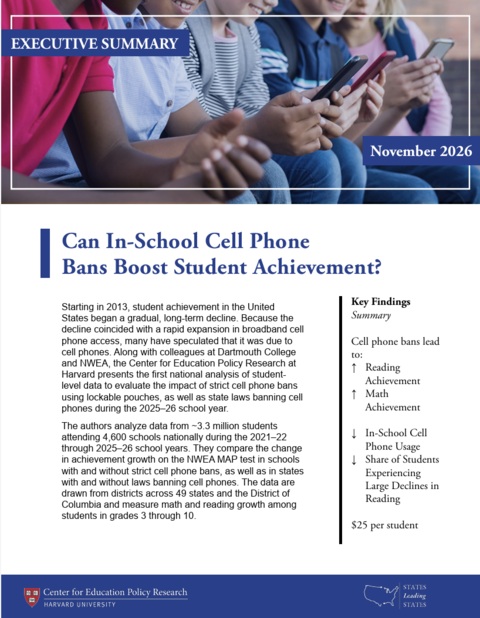
[### Executive Summary: Can In-School Cell Phone Bans Boost Student Achievement?
](/resource/phone-free-schools-summary)This executive summary breaks down the first national analysis of school cell phone bans using student-level achievement growth in the United States.
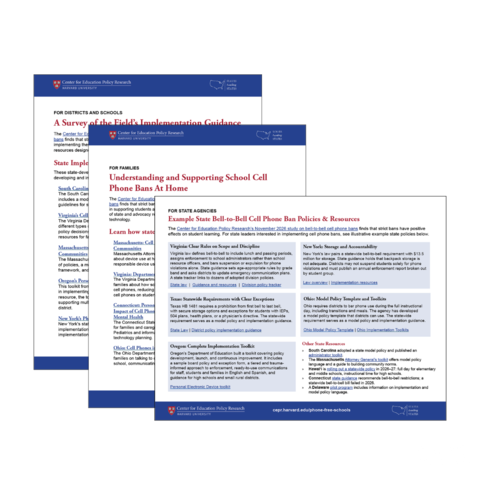
[### Implementation Resources: Phone-Free Schools and Achievement Growth
](/resource/phone-free-schools-implementation)These cell phone ban implementation resources include model policies and implementation guidance for states, districts, schools, and families.
## Findings at a Glance
1 grade equivalent
The cumulative loss in learning from 2013–2024 for 8th graders
20 percent
The estimated reduction in number of cell phones used in schools post-ban
1–2 weeks
The estimated amount of additional learning per year without cell phones
~$25 per student
The cost to purchase pouches for a strict cell phone ban

### Tom Kane, co-author
"Around 2013, U.S. students started losing 2–3 weeks of learning each year. It’s been a slow leak that, over time, has put U.S. 8th graders almost a year behind. Recent in-school cell phone bans seem to plug about half of that leak."

### Doug Staiger, co-author
"While schools should not expect a large boost immediately, storing phones is a cost-effective way to add 1–2 weeks of instruction each year. That could add up over time, just as the initial declines did."
### Jonathan Haidt, Social Psychologist, NYU-Stern, Author, The Anxious Generation & Cofounder, The TAG Movement
“This is the first student-level analysis of the impact of Yondr pouches on achievement growth at the national level. Students in schools that locked phones away for the full day received a small boost in annual achievement in math and reading combined, a boost equivalent to one to two weeks of additional instructional time per year. While phone free schools are about much more than just test scores, **this signal of a positive effect is encouraging**. As schools become more skillful at implementing phone-free policies, and as they begin to reduce the distractions coming from school-issued computers on students’ desks, we expect that the academic benefits from reduced distraction will increase.”
## Next Steps
Strict in-school cell phone bans are effective at reducing student cell phone usage during the school day, and as a result, are an effective tool to modestly increase student academic achievement. However, continued research is still needed to understand the impacts of student cell phone use holistically—including usage outside of school and impacts on learning and non-learning outcomes, such as extracurricular activities and mental health—to begin to identify evidence-based solutions.
This work will require a collective effort from schools, parents, researchers, policymakers, and funders. The gradual decline in student learning began over a decade ago, and the more urgently we understand the impacts of cell phone use among adolescents and effective solutions to combat problematic use, the sooner we can begin reversing its negative consequences.
For those looking to learn more about implementing and understanding the impact of cell phone bans, view our resource compilations below:
[### Supporting the Future of Cell Phone Research
](https://cepr.harvard.edu/sites/g/files/omnuum9881/files/2026-11/SLS%20Call%20to%20Action%20for%20Future%20Research.pdf)For Researchers
Read and share CEPR's call to action on leveraging the recent Meta settlement to collect better data for monitoring the effects of the restrictions and identifying the benefits and costs for students.
[### Example State Bell-to-Bell Cell Phone Ban Policies & Resources
](https://cepr.harvard.edu/sites/g/files/omnuum9881/files/2026-11/State%20Resources.pdf)For State Agencies
Explore how states are approaching cell phone policies and supporting districts in designing and implementing bell-to-bell bans.
[### A Survey of the Field’s Implementation Guidance
](https://cepr.harvard.edu/sites/g/files/omnuum9881/files/2026-11/District%20Resources.pdf)For Districts and Schools
Learn best practices from states and advocacy organizations on how to implement bans successfully in districts and schools.
[### Understanding and Supporting School Cell Phone Bans At Home
](https://cepr.harvard.edu/sites/g/files/omnuum9881/files/2026-11/Family%20Resources.pdf)For Families and the Public
Access state resources for families on supporting technology use at home and help spread the word about the effectiveness of bell-to-bell bans.
## State Cell Phone Policies, 2025–2026
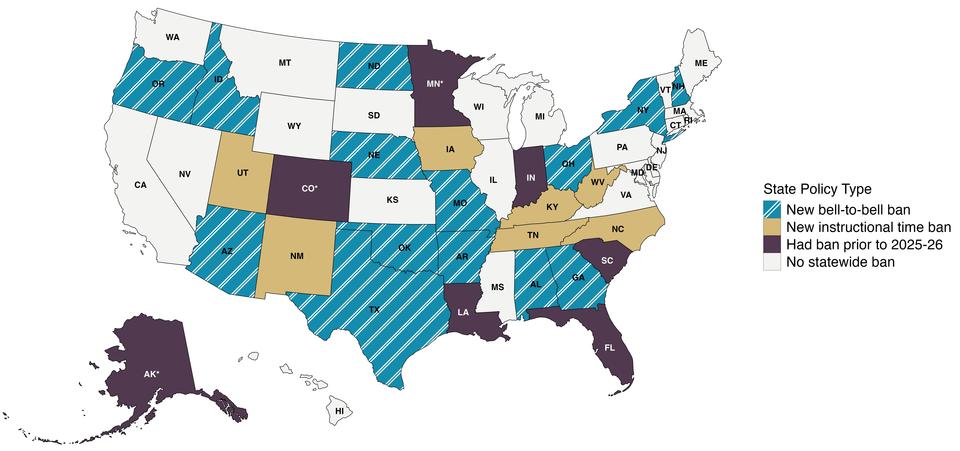
*Notes: Map documents state-level cell phone bans implemented for the 2025–2026 academic year. “Bans” include state policies that require schools or districts to limit or prohibit cell phone use during the school-day. “Bell-to-bell” bans are restrictions from the start of the day to the end, including non-instructional periods, whereas “instructional-time” bans just restrict phone use during instructional class time, but allow for cell phone use during non-instructional periods (including lunch, recess, etc.). States with an asterisk were excluded due to having a cell phone policy which couldn’t be categorized as either bell-to-bell or instructional time.*
## In the News
[### Strict Cell Phone Bans Restore 1–2 Weeks of Student Learning Each Year, Harvard Study Shows
](/cell-phone-press-release) November 17, 2026
Today, Dr. Tom Kane, Faculty Director of the Center for Education Policy Research (CEPR) at Harvard University, in partnership with researchers at NWEA and Dartmouth, released findings from the first national analysis comparing achievement growth for...
phone\_android
[### Return to Cell Phone Policies Homepage
](https://cepr.harvard.edu/cellphones)
home
[### Return to States Leading States Homepage
](/sls)